
There’s a moment, every so often, when a society realizes it’s no longer living the story it tells itself. For the United States in the early 2020s, that moment may already be here.
From the outside, the country still looks prosperous: corporations post record profits, stock markets hover near highs, technology advances march on. Inside too many homes, however, something else is happening. The tide of economic i+nequality is slowly rising. The foundation is cracking. The promise that hard work adds up to a better life feels like a story from another era.
The Rising Tide of Wealth
The ultra-wealthy are getting richer at a pace most of us cannot imagine. The top 1 percent of U.S. households averaged 139 times the income of the bottom 20 percent in 2021. [1] Corporate profits reached nearly $4 trillion by the end of 2024 — more than double what they were just over a decade ago. [2] And yet, for many working Americans, wages barely rise enough to keep up. [3]
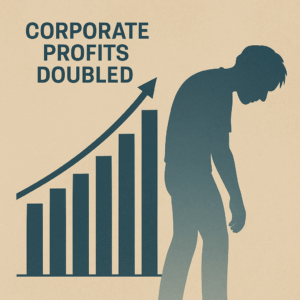
Even conservative-leaning economists admit it: wage growth hasn’t kept pace with productivity or cost of living. [4] The free-market researchers at the American Enterprise Institute note that while economic inequality gets attention, it’s the sense that the system isn’t built for everyone that keeps people fired up. [5]
In short: the system is working — for someone. But for most, it feels rigged.
The Weariness of the Many
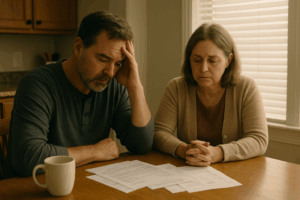
And what about the rest of us — the middle-wage earners, the working families, the people who still show up every morning? They’ve seen the headlines. Record profits. Soaring CEO pay. Every quarter, “growth.” Yet somehow, the paycheck never seems to grow up with it. Rent goes up. Groceries go up. Health insurance goes up. Hope goes down.
It’s not only that the gap is wide — it’s what the gap does to people. It wears them down. When work no longer adds up to security, when leadership turns into theater, when both sides of the political aisle seem too busy shouting at each other to stand up for anyone else, people start to drift away. They stop believing in the idea of “us.” They stop looking for solutions. They just look for someone to blame.
Some call it apathy. Others call it survival. Either way, it divides us. And the more divided we are, the easier we are to control. The fight isn’t left versus right anymore. It’s the few who profit versus the many who keep everything running. It’s the system telling us who to fight while it counts up the spoils.
The Mirror We’re Avoiding
So what’s the real story here? Not red vs blue. Not urban vs rural. It’s not about party lines or labels. It’s about what happens when power, profit, and pride outweigh purpose.
Human nature plays its part. When people gain wealth or control, most want more. More growth, more reach, more comfort. That’s not evil — it’s instinct. But unchecked, it hollows out nations. When ambition stops serving the common good, inequality grows like a shadow that stretches across generations.
And the people beneath that shadow start turning on each other instead of looking up at what’s blocking the light. They join parties that no longer represent them. They argue online instead of standing together. They forget that they were once united.
The Cost of Division
The price of division is paid in quiet ways: families too tired to talk about politics, voters who’ve stopped showing up, small towns hollowed out while megacities eat up opportunity. And as we fight among ourselves, other nations build up — their economies, their infrastructure, their influence.
Even business-minded analysts now warn that if wage stagnation continues, America’s global strength will erode. [4] That’s not a partisan view — it’s arithmetic. A nation cannot stay united when its people feel left behind.
A Subtle Call to Togetherness
This isn’t a call to arms. It’s a call to wake up. If you’re reading this, you already sense it: the fatigue, the frustration, the growing disbelief that anyone in office speaks for you. Maybe you’ve stopped caring which party wins — maybe you’ve decided they all sound the same.

But what if the solution isn’t to pick a side? What if it’s to stand up for something new? Something united — a movement built from the middle out instead of the top down.
Maybe the answer isn’t to tear down the system, but to build up a better one — together. Not left, not right, but forward. A movement that acts less like a party and more like a promise: to look out for each other again.
For those willing to think differently, to rise up quietly but steadily, Together Americans Can Overcome is here. This is where the conversation begins — about who we are, who we’ve become, and how we climb back up, united.
Because the hardest part of change isn’t rising up — it’s waking up.
What do you think?
Is The Great Divide, the growing wealth gap in the US, currently a serious issue for you? Do you think it’s a cause of the fading productivity of the American workforce, specifically the lower earning employees? Join the conversation and let us know what you think.