
The Great Divide Is Real, but It Is Not Inevitable
Nations rarely break all at once. They erode gradually — through distrust, division, and the weakening of shared purpose. That was true in the years before the Great Depression, and it is true whenever societies allow fractures to deepen beyond repair. But history also teaches another lesson: division is not destiny. The United States has pulled back from the brink before, and when it did so, it was because everyday Americans recognized their shared challenges and stood together.
Today, we again hear echoes of the 1920s and early 1930s, a period defined not only by economic turbulence but by widening social and political divides. What many saw then as left versus right was, in hindsight, a struggle between the powerful few and the vast majority whose livelihoods hung in the balance. The Great Divide of that era was not partisan — it was structural. And that is the warning embedded in this moment, too.
This installment explores how The Great Divide — an economic, political, and social chasm — weakens nations from the inside. But just as important, it explains why the divide can still be closed if the 99% rediscover their collective voice and demand a future built for all, not just the few at the top.
Division Weakens National Resilience
Fragmented Societies Respond Poorly to Crises
A nation’s resilience depends on the willingness of its people to cooperate when it matters most. In the late 1920s, political infighting and public distrust undermined early responses to the economic downturn. As markets trembled and unemployment surged, leaders hesitated, parties argued, and the country’s ability to act decisively eroded. Unity didn’t break overnight — it dissolved drip by drip as citizens and institutions turned inward.
The same pattern appears whenever societies grow polarized. Division erodes trust. Cooperation becomes rare. Sacrifice becomes selective. And coordinated responses — especially during crises — become far more difficult. Recent research shows that highly polarized nations experience slower governmental response times, reduced civic compliance, and greater economic damage during national emergencies.
This matters because division doesn’t just weaken responses — it fuels more extreme political swings.
When meeting in the middle becomes culturally taboo, the pendulum swings harder and farther with every election. Moderate solutions disappear. Governance whiplashes between extremes. This escalation mirrors the ideological volatility seen in multiple democracies during the early 20th century — a period of rising unrest, rapid political turnover, and mounting public anxiety.

A society that cannot compromise invites instability. The Great Divide magnifies every problem and slows every solution.
Distrust in Institutions = Fragile Systems
Every democracy depends on public trust. Not blind trust — but enough trust that people believe the system can function. In the years before the Depression, faith in institutions eroded sharply: trust in banks, political parties, and regulatory bodies weakened long before the crash. By the time crisis hit, much of the country doubted the competence or integrity of its leaders.
We see the same dynamic in divided societies today. When trust declines, people become harder to govern. They question motives, resist policy changes, and disengage from civic life. The system becomes fragile — not because people are wrong to demand better, but because distrust creates a vacuum that governments struggle to fill.
And in that vacuum, governments often respond in the worst possible way: by becoming more authoritarian.
Political scientists note that when democratic institutions lose legitimacy, leaders frequently expand executive authority, bypass debate, or centralize power to “restore order.” These shifts rarely occur all at once. They creep in — justified by crisis, fueled by division, and normalized by exhaustion.
The Great Divide does not only weaken institutions. It incentivizes leaders to compensate for that weakness in ways that strain democracy further.
Economic Divides Create National Weakness
When the Wealth Gap Widens, Social Tension Rises
Economic inequality is not just a matter of fairness — it is a matter of national stability. In the late 1920s, the top 0.1% controlled a disproportionate share of national wealth, while wages for ordinary workers stagnated even as productivity soared. This imbalance weakened consumer demand, increased household vulnerability, and made the entire economy more fragile.
Today’s wealth concentration parallels — and in some measures exceeds — those pre-Depression levels. Research shows that when wealth becomes too concentrated, national cohesion deteriorates. Social trust declines, political resentment rises, and civic engagement fractures along class lines. The more economic pressure everyday families feel, the harder it becomes to maintain the shared identity needed for a thriving democracy.
The Cost of a Shrinking Middle Class
Historically, America’s strength rested on a large, stable middle class. A family with a steady income, a modest home, and a sense of upward possibility formed the backbone of national confidence. When the middle class thrives, the entire nation thrives.
But when the middle class shrinks, national resilience declines. That was true leading up to the Depression, and it is true in any era where economic mobility contracts.
And today, the American Dream has become harder to sell — and even harder to believe.
Instead of asking, “When will I buy a home?”, millions now ask, “Will I ever be able to afford one?”
Instead of dreaming of college, families ask whether student debt will bury them.
Instead of building savings, households ask how to keep the lights on.
Most people aren’t aspiring upward — they’re trying to survive downward pressure.
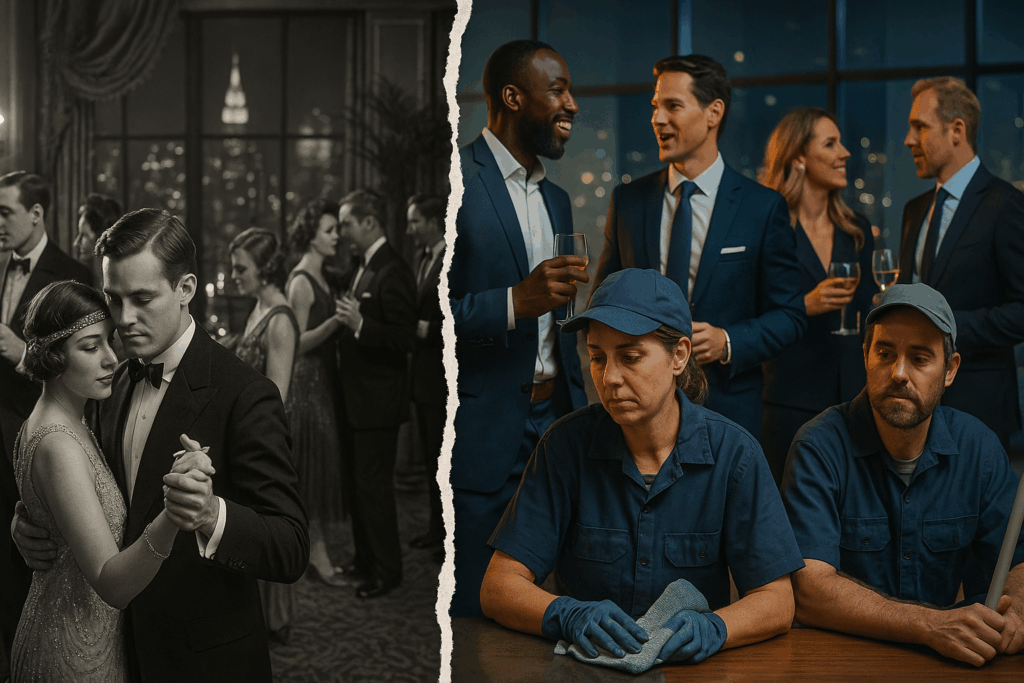
The dream of secure, comfortable, not-extravagant living has slipped out of reach for many. And when the majority feels left behind, societies destabilize. History repeatedly shows that national unity cannot hold when only a small fraction enjoys the benefits of prosperity.
Polarization Helps the Top 1% Retain Power
Economic inequality and political division reinforce each other. The more divided a population becomes, the easier it is for elites to maintain influence and avoid accountability.
We all see the photos, former presidents, senators, governors — Democrats and Republicans — laughing together at a gala. They’re always smiling because here’s the secret: they’re on the same team, and it’s not the same team the rest of us are on.
This isn’t cynicism. It’s pattern recognition.
In both the 1920s and today, wealthy elites across party lines have consistently benefitted from a divided public. When citizens are encouraged to fight one another, they rarely unite to demand structural reform. And when the 99% is fractured, the 1% remains firmly in control of economic and political power.
Historically, elites preferred a fragmented society because collective bargaining, unified voting blocs, and cross-party coalitions threatened their interests. The Great Divide keeps the many distracted, overwhelmed, and exhausted — while the few remain aligned and protected.
Political Division Paralyzes Governance
Gridlock and Zero-Sum Politics
In the years before the Depression, Congress frequently deadlocked on key measures, unable to agree on action even as economic warning signs grew. Committees stalled. Legislation languished. The belief that compromise was weakness became politically fashionable.
This pattern repeats whenever political actors prioritize winning over governing. As polarization intensifies, decision-making slows. Essential reforms get delayed or buried. And citizens lose faith in their representatives.
Political science research shows that highly polarized legislatures pass fewer bills, act more slowly in crises, and generate less durable policy outcomes. The result? A government that struggles to function, even when the public overwhelmingly supports action.
The Two-Party Trap
The structure of America’s electoral system funnels political competition into a winner-take-all binary — one winner, one loser. That dynamic encourages parties to mobilize their bases by vilifying the opposition, not by appealing to the middle. The more each side demonizes the other, the more entrenched the divide becomes.
Moderate positions evaporate. Compromise becomes a liability. Policy innovation dries up. And the views of the majority — including independents — get drowned out by the loudest partisan voices.
The Rise of Extremes When the Center Collapses
Throughout history, societies that lose their political center tend to experience a rapid rise in extreme ideologies. The Weimar Republic, parts of Latin America, and even the United States during certain populist waves all saw this dynamic unfold.
When the middle cannot hold, extremes rush to fill the vacuum:
- conspiracy movements
- authoritarian rhetoric
- radicalized factions
- distrust of elections
- escalating culture wars
As the center weakens, the question becomes less, “Who has the better ideas?” and more,
“Where does this end?”
“How far does it go?”
“How long do we ride this out?”
Or, to borrow Ozzy’s phrasing:
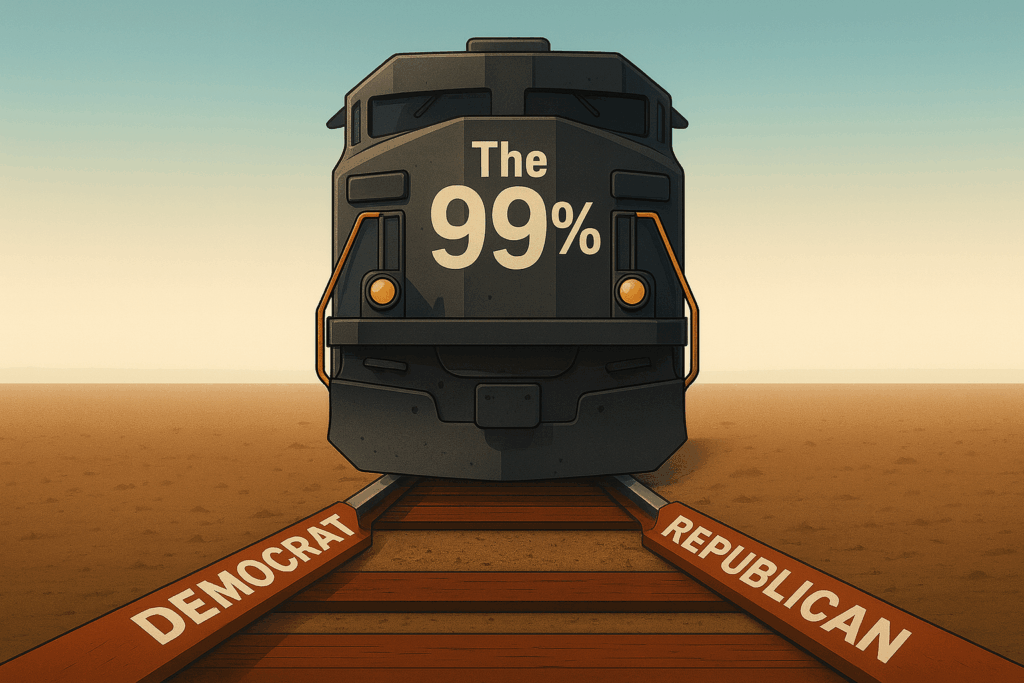
We’re goin’ off the rails on this Crazy Train.
It’s been noted that Ozzy Osbourne’s “Crazy Train” references the Cold War, singing of dictators in the line: One person conditioned to rule and control. The metaphor fits — we are warned, loudly, when the center collapses.
And here’s the poly-partisan truth:
Both major parties have contributed to the extremism. Neither can claim innocence.
The Great Divide is not red versus blue — it is the many versus the few who benefit from the chaos.
Social Fragmentation Erodes National Cohesion
Shared Culture Breaks Down Under Division
Nations are built not just on laws and institutions, but on shared identity—an understanding, however loose, that we are part of the same story. During the late 1920s and early 1930s, that shared identity began to fracture. Urban and rural America increasingly viewed one another through suspicion. Class divides deepened. Cultural differences, once tolerated, hardened into ideological trenches.
Social fragmentation weakens national cohesion by eroding the common ground needed for cooperation. When citizens begin identifying more strongly with their political or cultural tribe than their nation, unity dissolves. The result is a society that struggles to build consensus on even the most basic questions:
What matters? Who matters? What are we trying to build?
Modern research shows that highly polarized societies experience lower levels of interpersonal trust, more antagonistic public discourse, and greater hostility toward opposing viewpoints. When people see political opponents not as fellow citizens but as existential threats, the cultural fabric tears.
Division Makes the Nation Easier to Manipulate
Fragmentation doesn’t just weaken a society from within—it exposes it to manipulation from outside and within. During the 1930s, propaganda campaigns successfully exploited ideological divides across multiple nations. In the U.S., misinformation spread through radio broadcasts, political pamphlets, and sensational headlines fueled unrest and paranoia.
Today’s digital ecosystem accelerates that dynamic exponentially. Social media algorithms amplify conflict because conflict drives engagement. Coordinated misinformation—from foreign actors, domestic extremists, and opportunistic influencers—spreads easily in environments where citizens no longer trust one another.
A fractured public is an easy target.
A united public is not.
When The Great Divide widens, manipulation becomes painless: amplify fear, target isolation, exploit resentment, and let the divisions metastasize. Social fragmentation leaves a nation vulnerable not because its enemies are strong, but because its unity is weak.
The Great Divide Is Not a Foregone Conclusion
Despite everything—despite the widening inequality, the partisan hostility, the social fragmentation—history offers a powerful reminder: nations can reverse these trends. The divide can be narrowed. Unity can be rebuilt. And the many can reclaim power from the few.
How the 99% Realign When Unity Breaks Through
During the Great Depression, everyday Americans—farmworkers, factory laborers, teachers, clerks, veterans—found themselves facing a shared struggle powerful enough to transcend political identity. People who had never considered themselves part of the same movement realized they had more in common with one another than with the elites making decisions above them.
This recognition fueled a collective shift.
It powered the civic coalitions that demanded accountability, reform, and relief.
It helped birth the New Deal—one of the most transformative eras of American governance.
Across the political spectrum, people organized, voted, marched, negotiated, and collaborated. Not because they agreed on everything, but because they agreed on one thing: they were stronger together than divided.
This is the key lesson from that era:
when the many unite, the nation can change course.
The 99% has always held the greatest potential to steer the country away from collapse and toward renewal.
The Great Divide Is Not a Foregone Conclusion
Why Division Is Fixable Today
Division feels permanent only when people feel powerless. But history is full of turning points where public will reshaped entire systems. The Great Depression was one. The Progressive Era before it was another. Civil rights movements, labor movements, voting rights movements—each was driven not by elites but by ordinary Americans who refused to accept the status quo.
Today, the issues are different in form but similar in function:
- widening inequality
- concentrated wealth and power
- political paralysis
- a shrinking middle class
- anger without accountability
- mistrust without reform
But none of these problems are insurmountable.
Division can be fixed because it is human-made, not an immutable fact of nature.
Polarization didn’t appear overnight—it was built over decades by incentives that reward conflict, media ecosystems that amplify outrage, and political structures that protect power. What is built can be dismantled. What is taught can be unlearned.
Several modern civic shifts show how quickly public engagement can alter the landscape:
- Young voters have become one of the most politically active generations in modern U.S. history.
- Independents now make up the largest voter group in the nation.
- Ballot initiatives—red state and blue state—have passed reforms by overwhelming margins when politicians failed to act.
- Community-led organizations have strengthened local governance, restored trust, and driven bipartisan cooperation.
Across the political spectrum, people are beginning to resist division—not by aligning with one party or the other, but by seeking representation that represents our own needs and works for the many instead of the few.
And this is crucial:
You don’t need a political majority to change the direction of a nation. You only need a civic one.
A coalition built across class lines, regardless of party, is historically the most powerful force in American politics. When the 99% sees its shared interest clearly, The Great Divide stops widening.
This isn’t pollyannish. It’s proven.
The Great Depression ended not because elites suddenly grew benevolent but because millions of ordinary Americans—left, right, and center—participated, voted, organized, demanded reform, and rebuilt the country from the bottom up.
We have done it before. We can do it again.
Conclusion — A Nation Rebuilt from the Middle Out
The deepening fractures we see today echo the late 1920s not just economically, but socially and politically. The Great Divide weakens nations not because people disagree—disagreement is healthy—but because the divide convinces people to see one another as enemies rather than as fellow citizens with shared fates.
That is the warning history offers.
But it also offers a promise.
Division is not destiny.
It is a choice.
And unity—real unity, grounded in fairness, representation, and shared purpose—is also a choice.
The 1% are powerful, but not more powerful than the majority of the country. Political elites are influential, but not more influential than millions of Americans standing together. The Great Divide persists only when the 99% forgets that it has always been the driving force behind reform, recovery, and national renewal.
If we want a stronger, fairer, more stable United States, we don’t need to erase our differences. We need to recognize our common ground. We need to see past the partisan theater designed to keep us divided. We need to unite our voices and—most importantly—our votes.
That is how nations pull back from the brink.
That is how they build again.
And that is how we can ensure that the next chapter of our story looks nothing like the darkest moments of the past.
The Great Divide weakens a nation.
But the unity of its people can strengthen it.
And if history has taught us anything, it’s that when Americans can kick some ass when we need to. It’s time. We’re goin’ off the rails on this crazy train, but Together, Americans Can Overcome.